What actually separates one quad bike tier from another, mechanically?
Three variables actually matter: engine displacement, drivetrain tuning and kerb weight. Displacement sets the power ceiling, weight decides how forgiving that power feels underneath you, and drivetrain tuning determines how much of it reaches the sand smoothly rather than in one grabby lump.
Displacement is the number everyone quotes first and the one that matters least on its own. A 90cc and a 220cc are both small-displacement machines, but the 90cc is speed-governed at the factory while the 220cc is not, which is a bigger practical difference than the 130cc gap suggests. Once you move into the adult range, displacement tracks power fairly linearly: the 400cc carries close to double the 220's torque, and the 625cc and 700cc classes add another step again, mostly through breathing and compression rather than sheer physical size.
Weight matters more than most first-time riders expect, because it changes how a machine responds when you get something wrong. A lighter frame corrects easily when you pick a poor line on a soft dune face; a heavier one holds its line but punishes hesitation more. That is the real difference between the 220cc, which is genuinely the lightest machine in the adult class, and something like the Grizzly 450cc, a heavier utility frame built to stay planted over broken ground rather than to feel nimble underneath a new rider.
Drivetrain tuning is the variable buyers ask about least and probably should ask about most. Every machine in this fleet is single-speed automatic with a centrifugal clutch, so there is no gear shifting to learn regardless of class. What changes between tiers is throttle mapping and, on the turbo 400, forced induction added to the standard engine rather than a larger displacement block underneath it. Two machines with similar cc numbers can still feel completely different once the throttle tuning is factored in.
None of this shows up on a price list, which is why the class-by-class breakdown above leads with the mechanical difference rather than a marketing label. If you are choosing between two adjacent tiers, the honest question is not which one is faster, but which spec you actually want to manage for an hour: more torque and more weight, or less of both at once.
Is a “quad bike” the same thing as an “ATV”?
Yes, mechanically. ATV stands for all-terrain vehicle and leans North American; quad or quad bike is the phrase that gets used here and across most of the Gulf. Any listing carrying either word is describing the same four-wheeled, single-rider machine.
The confusion is entirely regional vocabulary, not a product distinction. In the United States and Canada, ATV is the default term and shows up on manufacturer badging, insurance paperwork and road-registration rules. In the UK, Australia, the Gulf and most of Asia, the word that gets used in conversation and on booking pages is quad or quad bike, even though the hardware underneath is identical.
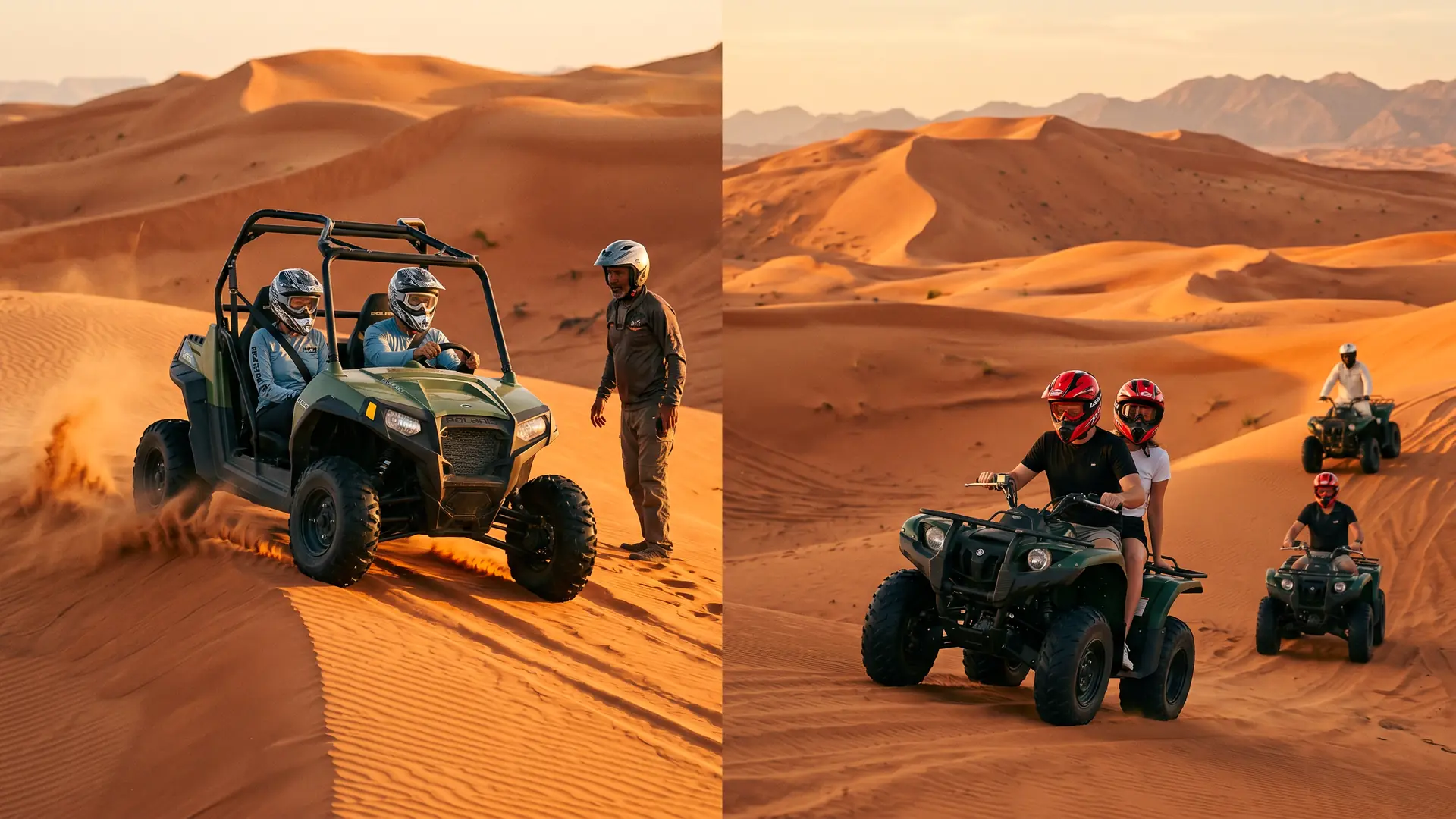
Where it gets genuinely confusing is “side-by-side,” which is a different vehicle category entirely, not a regional synonym. A side-by-side, also sold under the label UTV, has a steering wheel, bucket seats and foot pedals like a car, which is exactly what a dune buggy is. A quad or ATV always has handlebars, a straddle seat, and steers through a combination of the bars and your own body weight. If a listing shows a machine with a steering wheel and still calls it a quad, that is a labelling error rather than a regional variant.
One more distinction worth knowing: some markets use “quad bike” loosely to include three-wheeled machines, which mostly disappeared from production decades ago on safety grounds. Everything in this fleet, and everything most operators run today, is the four-wheeled configuration regardless of which word appears on the page.
For booking purposes the terms are fully interchangeable, so searching either word should surface the same machines. If a price looks unusually low for something marketed as an “ATV tour,” it is worth checking whether it is actually a full quad session or a shorter static ride, since the vocabulary gap occasionally gets used to soften a shorter package rather than describe a different machine.
What is the realistic lifespan of a rental quad, and should it change what you book?
A well-maintained rental quad in commercial use typically runs several seasons before major components need replacing, and that lifespan depends far more on maintenance discipline than on which class you book. What should actually influence your choice is how a machine's condition is checked before it reaches you, not its age.
Desert use is hard on any vehicle. Sand works into bearings, clutches and air filters faster than road use ever would, and a machine ridden daily in these conditions needs components replaced on a schedule measured in months rather than years. That holds true across every class equally: the governed 90cc kids machine takes on just as much sand ingestion as the Raptor, proportionally, because both run the identical dunes.
What differs by class is how much a worn component actually matters to your ride. A slightly soft clutch on a 220cc is barely noticeable, because the whole machine is tuned gentle to begin with. The same wear on a 625cc or 700cc, where throttle response is supposed to be sharp, would be obvious immediately, which is one practical reason the higher tiers get checked more frequently rather than on a fixed calendar.
Durability is also why the double-seat 400cc and the standard 400cc share a lifespan rather than the double wearing out faster. Both use the identical engine block; the double simply carries more structural mass in the frame and rear subframe, not a harder-worked motor underneath. The age of a specific unit is less useful to know than its maintenance record, which is the actual reason the inspection step happens before every handover instead of on a rotating schedule.
None of this should change which class you book. It should change what you check for at handover: listen for anything rough at idle, ask whether the machine has already been inspected that day, and treat a straight answer from the guide as more meaningful than a fresh coat of paint.
Automatic or manual-style throttle control: do you get a choice?
No manual-shift option exists in this fleet, and that is standard for rental quads generally. Every machine is single-speed automatic with a centrifugal clutch: twist or thumb the throttle and the machine handles gear selection on its own. What changes between classes is how that throttle is mapped, not whether you shift.
This surprises riders who have used a manual motorbike or a manual car, where automatic usually implies a simpler, less involved machine. On a quad it means something different: automatic transmission is close to universal even on machines built for serious off-road use, because clutch and gear management on rough terrain adds a failure point most riders do not want while they are already managing body position and throttle at the same time.
Where the classes genuinely differ is throttle response curve. The 220cc is mapped soft, meaning the same twist of the wrist delivers noticeably less immediate power than the identical movement on a 625cc or Raptor 700cc, which are mapped for a rider who actively wants that response. The turbo 400 keeps the standard 400's gentle low-end mapping but adds a stronger top end once boost arrives, which is why it reads as familiar rather than intimidating to someone stepping up from the standard model.
Thumb throttle versus twist-grip is the other variable, and it is a comfort preference rather than a skill difference. Most of this fleet uses thumb-operated throttle, which some riders find easier to modulate precisely at low speed during the warm-up. Neither style requires prior experience, and the machine chooser above covers which class suits a first-timer regardless of throttle type, with the briefing itself walking you through whichever your assigned machine uses.
What comes standard, and what costs extra across the different tiers?
Every class ships with the same core kit: a helmet, fuel for the duration booked, water kept cold, a briefing on the controls, an inspection before you get on, and a guide leading the route. Hotel pickup, a GoPro mount and riding gloves are the main things you either pay extra for or bring yourself.
The standard inclusion list does not shrink as you move up in machine class, which is worth knowing because some rental operators quietly do the opposite. A rider on the governed 90cc gets exactly the same helmet standard, water and inspection as someone booking the Raptor 700cc. What scales with class instead is the screening step: higher tiers add a conversation before handover, not a longer kit list underneath it.
What is genuinely not included, across every class: gloves, proper riding boots, a GoPro or chest mount, and hotel pickup. Closed shoes are the only footwear requirement enforced at the briefing, but they are the rider's own, not supplied on site. A buff or scarf for dust protection is worth packing for the same reason. Pickup from central Dubai locations is arranged and quoted separately, confirmed before payment rather than folded silently into the headline price.
Photos are the one genuine extra that is actually included at no charge: guides shoot images along the route and send them through afterward. It is easy to assume this is an upsell, since plenty of tourist activities charge for exactly this, which makes it worth confirming with any operator before booking if it matters to you.
The practical takeaway is to compare quotes on what is excluded, not on what is included, since the included list is close to identical everywhere serious. Hotel pickup fees vary more between operators than the base machine rate does, and that is usually where an apparently cheaper quote quietly catches up with a more transparent one.
How do rental quad bikes get maintained and inspected between riders?
Every machine gets a visual and functional check before it is handed to the next rider: brakes, throttle return, tyre pressure, fluid levels and, on the 90cc class specifically, the governor setting itself. This happens at the base, in front of you, rather than out of sight beforehand.
The inspection sequence is the same regardless of which class you are riding: brakes tested for bite and return, throttle checked for a clean return to idle, tyres checked for pressure and visible wear, fluid levels confirmed. On the governed 90cc, the speed limiter itself gets confirmed as part of that check, since it is the one component directly controlling what a nine-year-old can access.
Between sessions, sand is the main adversary and the main maintenance task. Air filters get checked far more often here than a manufacturer's standard service interval would suggest, because desert dust loads them faster than that schedule assumes. Chain and drivetrain components on the sport-class machines, which see harder use, get more frequent attention than the utility-class Grizzly, which is built with more mechanical margin from the factory to begin with.
This is also, honestly, part of the reason the screening conversation exists for the top-tier machines and not the lower ones. A rider who has been asked directly about their experience is less likely to push a machine past what it, or they, can actually handle, and a machine that is not being pushed past its limits needs less emergency attention afterward. The inspection step covered in the pickup-to-drop-off flow and the screening step are the same safety logic, applied at two different points in the day.
If you already ride a quad at home, how do these rental machines compare spec-for-spec?
Close to what you would expect from a commercial rental fleet rather than a personal machine: slightly detuned for consistency across many riders, but built on the same displacement classes and drivetrain logic as equivalent retail Yamaha models.
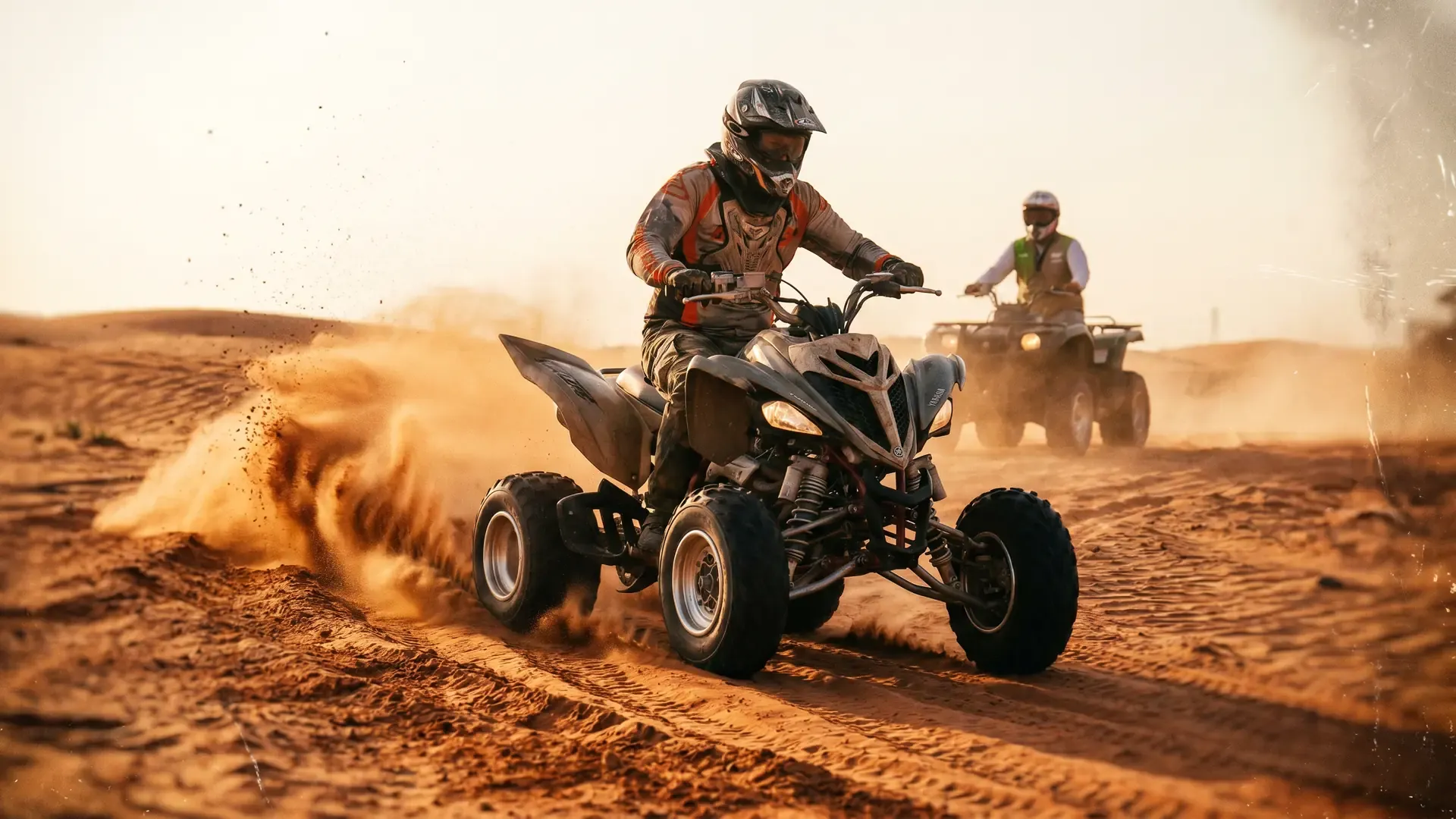
Riders who already own a quad tend to ask one specific question: is the throttle mapping softened for tourists compared with a retail machine of the same displacement. The honest answer is yes, modestly, on the lower tiers, because a fleet vehicle has to perform predictably across hundreds of different riders rather than one owner who has learned its exact behaviour over years. Both the 625cc sports class and the Raptor 700cc sit closer to retail tuning than the rest of the fleet, which is part of why those two are the ones that carry a screening step.
Suspension travel and ground clearance are close to unchanged from equivalent private-market machines, since those are structural rather than tunable. What actually differs is service interval and load cycling: a fleet machine completes far more start-stop cycles per week than almost any private owner would put on it in a year, which circles back to the durability question above rather than a spec difference you would feel mid-ride.
The most useful comparison point for an experienced rider is probably the 400cc turbo against a similarly sized home machine fitted with aftermarket forced induction. The fleet version is factory-calibrated rather than shop-tuned, so it behaves more conservatively at the top of the power band than a home-built equivalent might, which experienced riders occasionally read as underwhelming for the first few minutes, right up until they recalibrate to it.
People also search for
Guide FAQ
Is a 90cc and a 220cc really that different to ride?
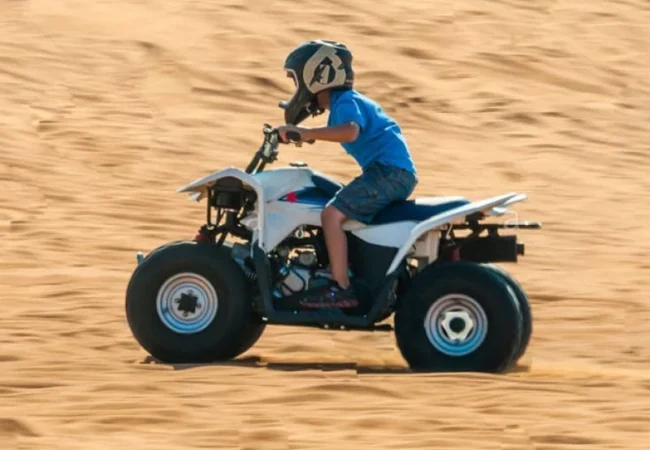
Yes, more than the numbers suggest. The 90cc is speed-governed and runs a marked track rather than open dune, while the 220cc has no governor and rides the same terrain as every adult machine. The gap in where they operate matters as much as the gap in displacement.
Do the machines have a reverse gear?
No class in the fleet has reverse. All eight machines are single-speed automatic with forward drive only, which is standard for this style of quad. Getting turned around on a slope is handled by the guide as part of a stuck-recovery, not by shifting into reverse.
What is the top speed of each class?
Not published as a spec-sheet number, because sessions run at guided pace rather than open throttle. The functional difference between classes shows up in acceleration and climbing power well before top speed ever becomes relevant on a guided dune loop.
Are the tyres different between machine classes?
Yes. Utility-class machines like the Grizzly run a wider, more aggressive tread for traction on broken ground, while the sport-class 625cc and Raptor run a lighter tyre tuned for handling response over ultimate grip. Tyre choice follows the machine's job, not its price tag.
Can I request a specific machine by name when I book?
You can request a class by name, such as the Raptor 700cc or the Grizzly 450cc, and it gets confirmed subject to availability. Requesting one specific individual unit is not something the booking system supports, since fleet allocation happens on the day itself.
Do rental quads come with any warranty or guarantee of condition?
Every machine is inspected before handover rather than carrying a formal written warranty, which is the more meaningful guarantee for a same-day rental. If anything feels wrong once you are on it, the guide swaps the machine rather than asking you to ride through it.
Is there a weight limit per machine?
There is no published hard limit, but the screening conversation for the 625cc and Raptor 700cc covers rider size and experience together, since both affect how the machine handles. If you are unsure, mention it on WhatsApp before booking rather than at the briefing.
What is actually different about the turbo 400 under the hood?
Forced induction added to the standard 400cc block rather than a larger engine swapped in. The chassis, gearing and low-speed throttle mapping stay the same as the standard 400, so the added power shows up once you are already moving, not off the line.
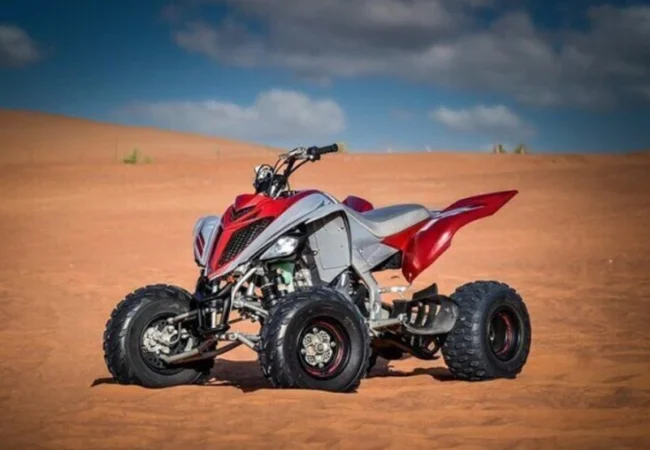
How is the Raptor 700cc different from the 625cc sports quad, mechanically?
Displacement is the obvious difference, but weight distribution matters just as much. The 625cc is built lighter and sharper for quick direction changes, while the Raptor 700cc carries more outright power on a chassis tuned to put it down predictably. Both are gated by the same screening step.
Do all classes use the same fuel and tank size?
Fuel type is the same across the fleet; tank size scales roughly with machine class, so the 90cc and 220cc carry less than the 625cc or Raptor. Every booking already has fuel for its duration built into the price, whatever class you ride, so tank size stays an operational detail rather than something you pay extra for.
 AED 150